
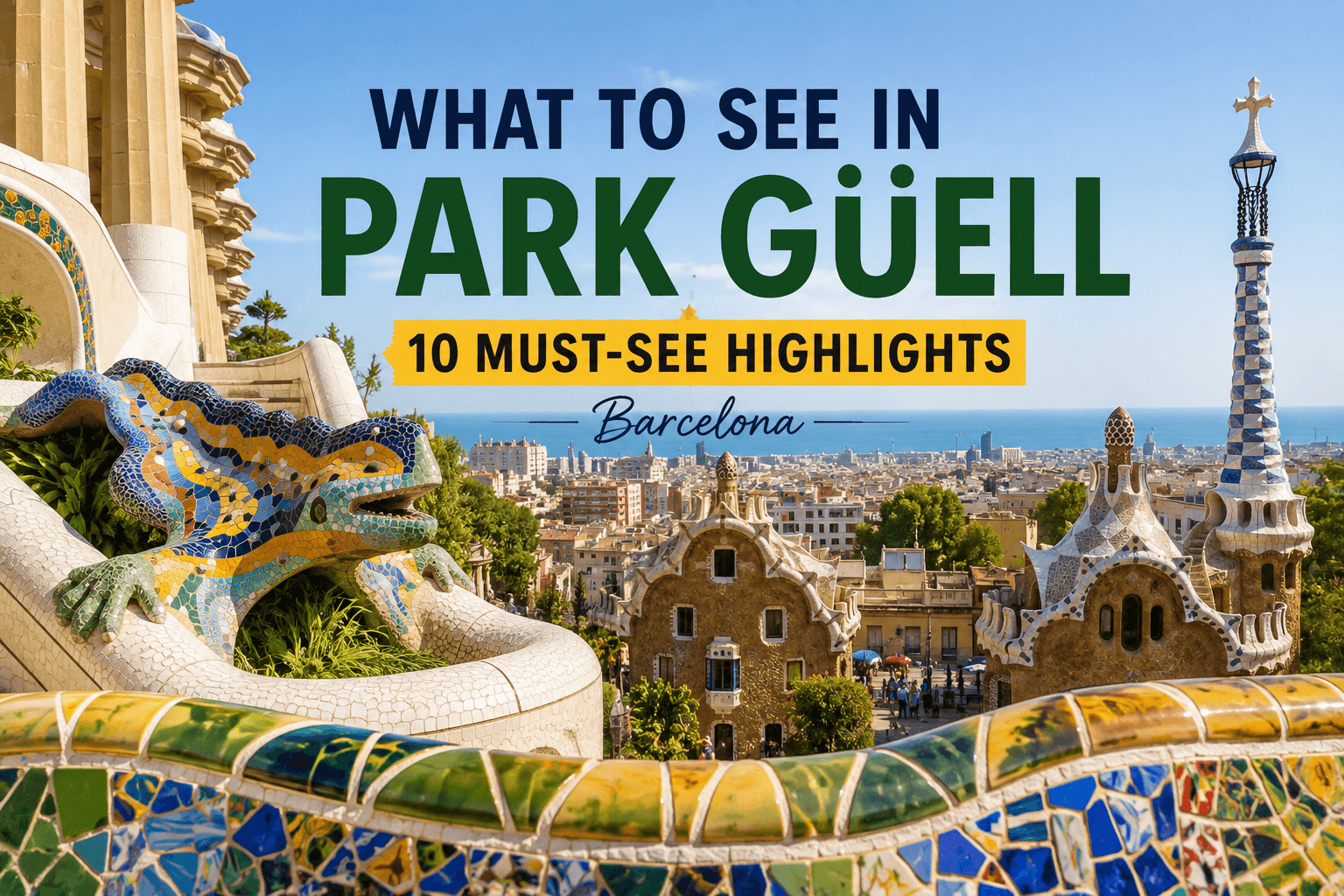
What to See in Park Güell – 10 Must-See Highlights
If you're visiting Park Güell in Barcelona, don't make the mistake of walking in, photographing the famous mosaic dragon and thinking you've seen the park.
Designed by Antoni Gaudí, Park Güell is filled with architectural details, colourful mosaics, unusual stone structures, panoramic viewpoints and spaces where architecture appears to grow directly from the landscape.
The famous Dragon Stairway and El Drac may be the most recognisable sights, but they're only the beginning.
From the sweeping mosaic bench of Nature Square to the forest-like columns of the Hypostyle Room and the organic stonework of the Laundry Room Portico, every part of the park reveals a different side of Gaudí's imagination.
If it's your first visit, these are the 10 Park Güell highlights you shouldn't miss.
Park Güell Must-See Attractions: Quick List
If you have limited time, prioritise these sights:
Park Güell Highlight | Why See It? | Priority |
|---|---|---|
Dragon Stairway & El Drac | Park Güell's famous mosaic salamander | ⭐⭐⭐ |
Nature Square | Panoramic Barcelona views | ⭐⭐⭐ |
Serpentine Mosaic Bench | Iconic Gaudí mosaics | ⭐⭐⭐ |
Hypostyle Room | 86 monumental columns | ⭐⭐⭐ |
Porter's Lodge Pavilions | Fairytale Gaudí architecture | ⭐⭐⭐ |
Laundry Room Portico | Dramatic organic stonework | ⭐⭐ |
Viaducts | Architecture integrated with nature | ⭐⭐ |
Austria Gardens | Quieter green space | ⭐ |
Gaudí House Museum | Gaudí's former residence | ⭐⭐ |
Park Güell Viewpoints | Barcelona skyline photography | ⭐⭐⭐ |
If you only have around an hour, concentrate on the Monumental Zone and the first five highlights.
If you have longer, explore the pathways and quieter areas as well.
1. Dragon Stairway & El Drac
If there is one image almost everyone associates with Park Güell, it's El Drac.
The colourful mosaic salamander sits on the monumental staircase near the main entrance and has become one of the most photographed works associated with Gaudí in Barcelona.
Its surface is covered in trencadís, Gaudí's distinctive mosaic technique using fragments of coloured ceramic.
But don't just photograph the salamander and move on.
Look around.
The entire staircase forms part of a carefully designed entrance sequence leading visitors upward toward the Hypostyle Room.
You'll see fountains, curved walls, mosaics and sculptural details incorporated into the architecture.
Why you shouldn't miss it
This is one of the most recognisable symbols of both Park Güell and Gaudí's Barcelona.
Photography tip
It becomes busy quickly.
If photographing El Drac without large crowds is important to you, an earlier visit generally gives you a better chance.
For help choosing your time slot, see our guide to the best time to visit Park Güell, including morning vs afternoon, crowds and photography.
2. The Serpentine Mosaic Bench
The long, curving mosaic bench surrounding Nature Square is another Park Güell icon.
From a distance, it appears like a colourful ribbon wrapping around the terrace.
Up close, you'll discover an enormous variety of:
colours
patterns
ceramic fragments
shapes
and
textures.
The bench is another famous example of trencadís mosaic work.
But its design isn't purely decorative.
Its undulating shape creates individual seating areas while following the curved edge of the terrace.
This combination of function, art and organic form is one of the reasons Gaudí's work remains so distinctive.
3. Nature Square
Directly beside the serpentine bench is Nature Square, one of the most important open spaces in Park Güell.
Originally conceived as a gathering area, the large terrace now provides one of the park's classic views across Barcelona.
From here, you can see the colourful entrance pavilions below and the city stretching toward the horizon.
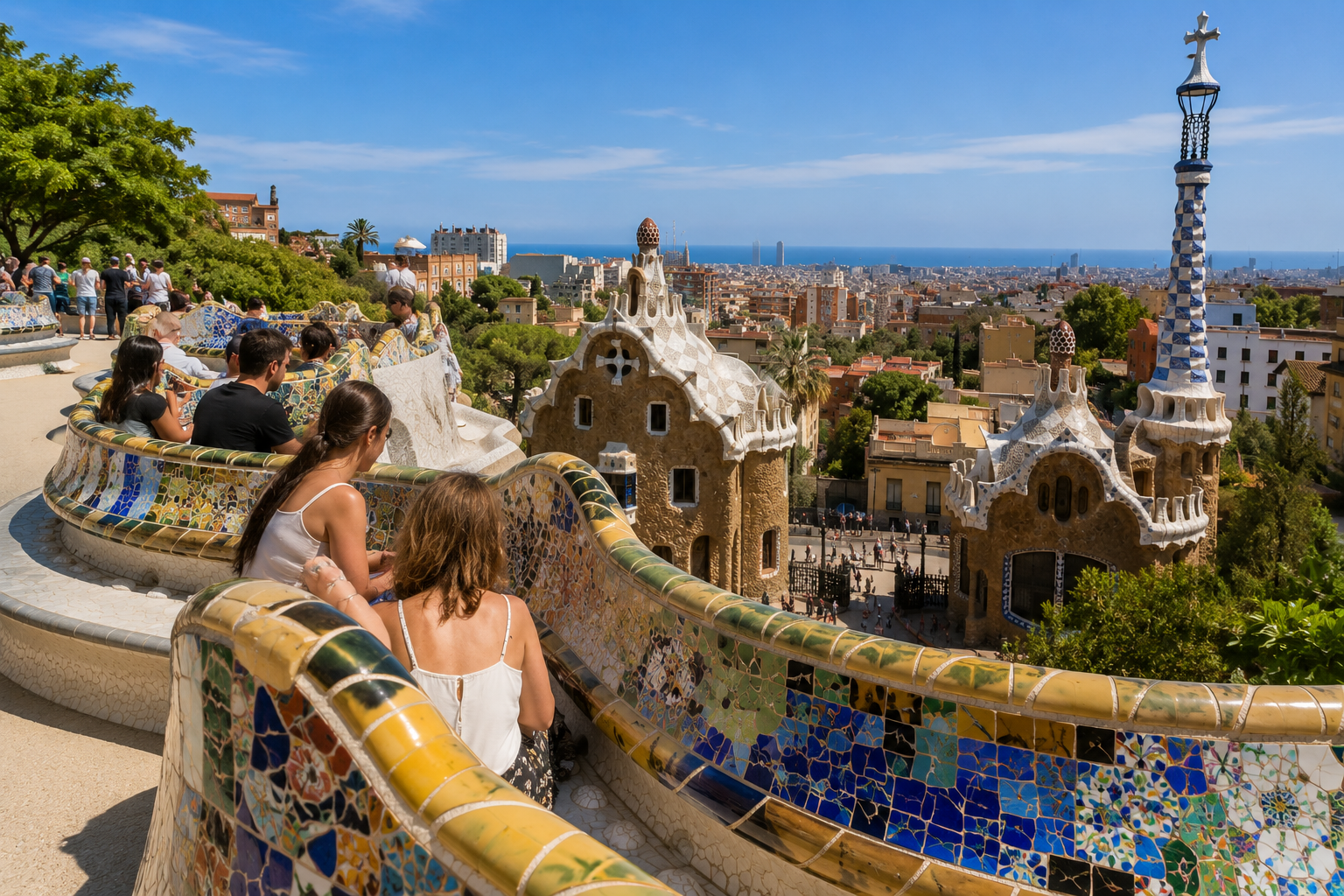
On clear days, the view can extend toward the Mediterranean.
This is where many of the famous photographs showing:
mosaic bench + Barcelona skyline + Sagrada Família
are taken.
Don't rush this part
Many visitors spend most of their time taking photographs.
Instead, give yourself a few minutes simply to enjoy the panorama.
Nature Square is one of the places where you can best understand how Gaudí used the park's elevated position as part of the experience.
4. The Hypostyle Room
Walk below Nature Square and you'll discover one of the most impressive architectural spaces in Park Güell:
The Hypostyle Room.
The room contains 86 Doric-inspired columns supporting the terrace above.
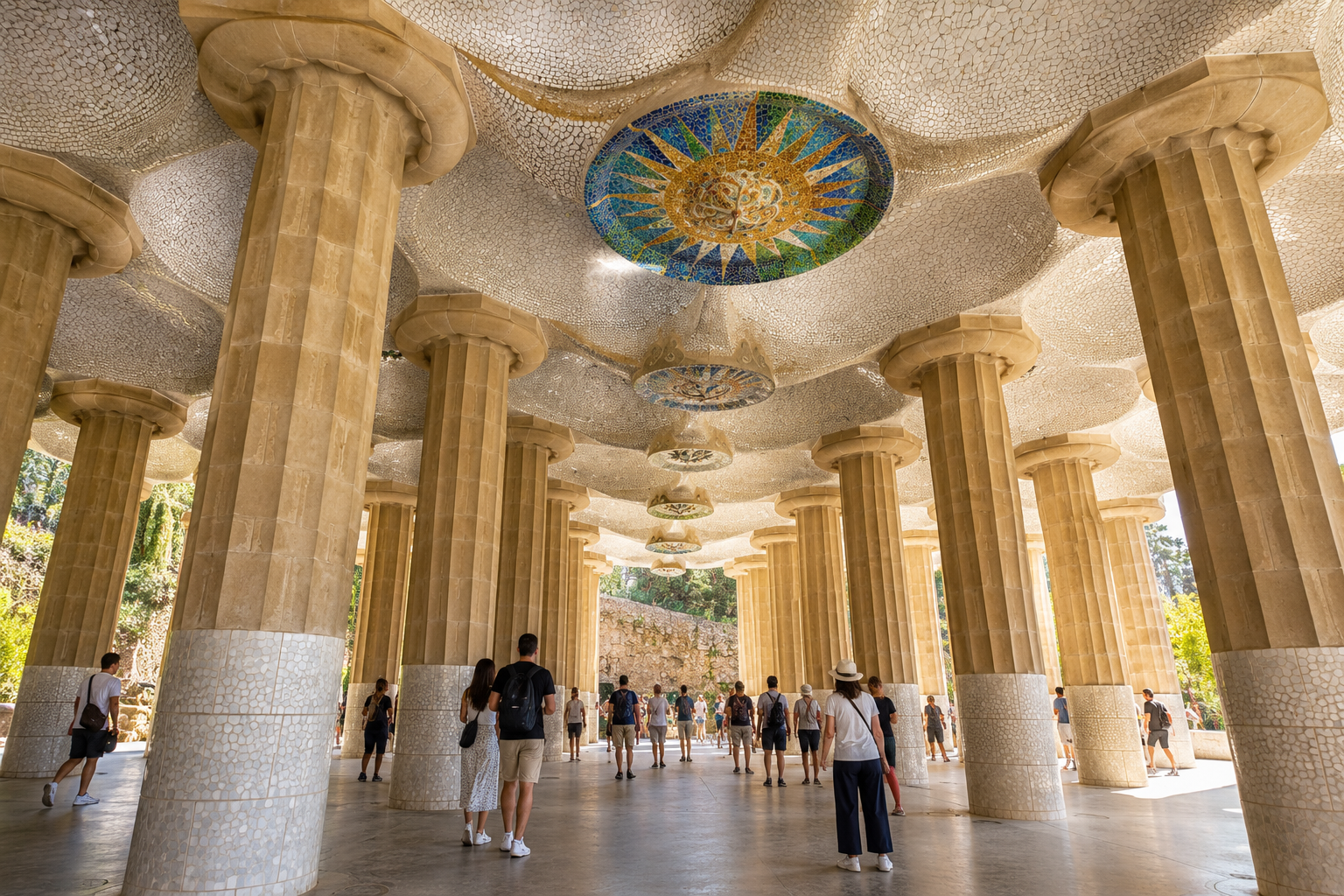
The effect is striking.
Standing among the columns can feel like walking through a stylised stone forest.
Look upward and you'll also find colourful mosaic decorations incorporated into the ceiling.
The space demonstrates something particularly important about Park Güell:
Gaudí wasn't simply creating decorative structures.
The architecture often performs several functions simultaneously.
The Hypostyle Room supports the enormous terrace above while forming one of the park's most visually memorable spaces below.
Why it's worth seeing with a guide
Without context, you may simply see an impressive room filled with columns.
Understanding its intended purpose, engineering and relationship with Nature Square makes the space considerably more interesting.
5. Porter's Lodge Pavilions
At the main entrance to Park Güell stand two buildings that look as though they've come from a fairytale.
These are the Porter's Lodge Pavilions.
Their curved roofs, irregular forms, colourful surfaces and decorative details immediately establish that you're entering somewhere unlike a conventional city park.
One originally served as a porter's lodge, while the other had administrative functions connected with the development.
The buildings are particularly striking when viewed from Nature Square above.
From that elevated position, their unusual roofs sit against the Barcelona skyline.
Look closely
The buildings demonstrate Gaudí's dislike of rigid architectural forms.
Curves dominate.
Straight lines become less important.
Architecture begins to resemble something almost natural.
6. The Laundry Room Portico
The Laundry Room Portico is one of the best places in Park Güell to understand Gaudí's ability to make architecture appear part of the landscape.
The stone columns lean dramatically inward, creating a covered walkway that feels as though it has been carved directly from the hillside.
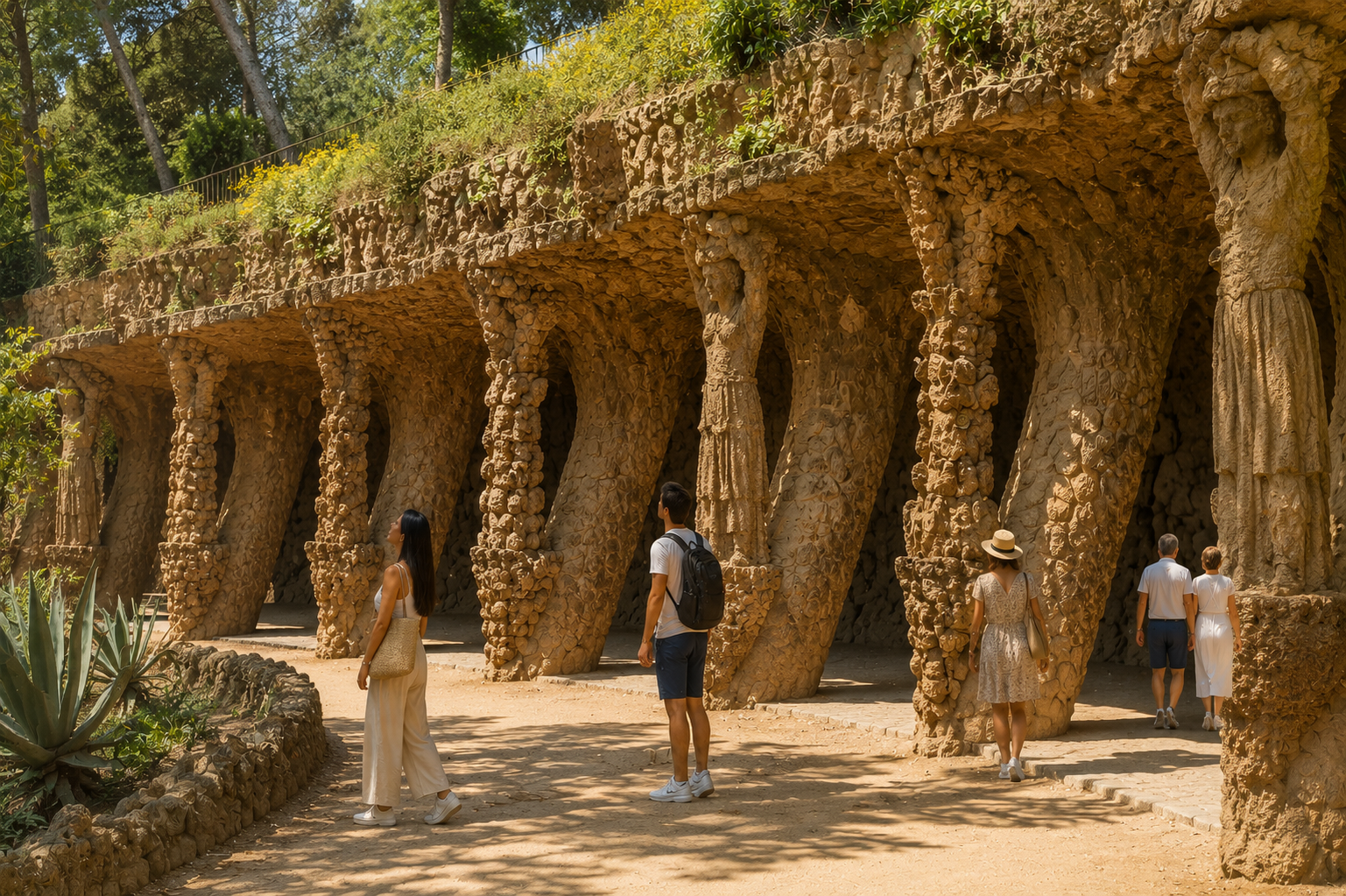
One of the columns takes the form of a female figure carrying a basket, which contributed to the walkway's name.
Compared with the colourful mosaics around the main entrance, this part of Park Güell uses much more natural stone.
The result is completely different.
Yet it still feels unmistakably Gaudí.
Why we like it
It demonstrates that Park Güell isn't simply about colourful mosaics.
Some of its most impressive architecture comes from stone, geometry and Gaudí's interpretation of natural forms.
7. Gaudí's Viaducts & Stone Pathways
As you move farther from the Monumental Zone, you'll encounter a network of viaducts designed to carry pedestrians and vehicles around the original residential development.
These structures are easy to overlook.
Don't.
The viaducts are among the clearest examples of Gaudí adapting architecture to the natural terrain.
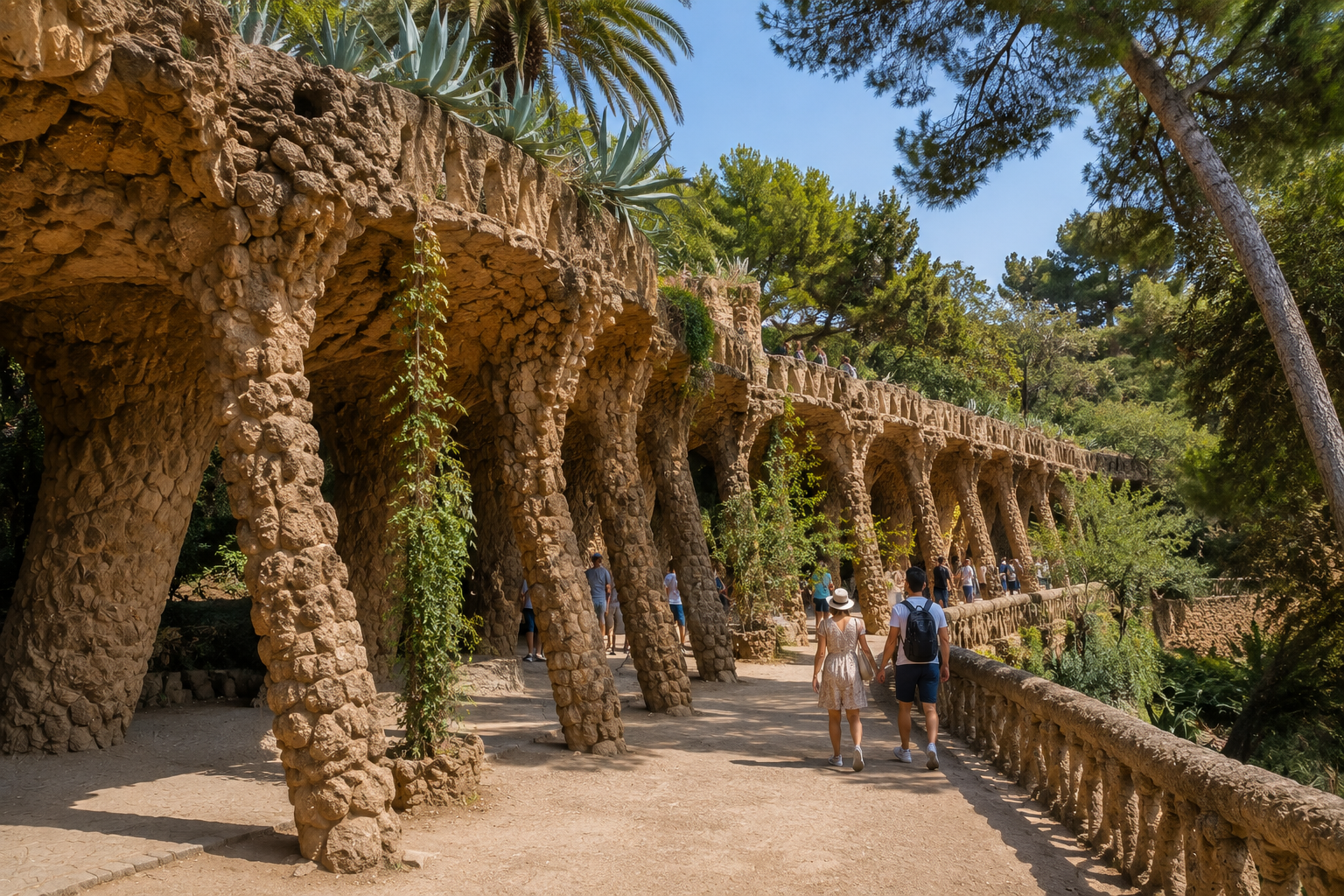
Instead of forcing conventional structures onto the hillside, the stone columns, arches and pathways follow the landscape.
Some columns lean.
Others branch or curve.
The rough stone surfaces echo the surrounding earth.
This creates the impression that the structures have always been part of the hill.
Take time to walk
This is where slowing down becomes worthwhile.
The farther you move from the busiest monumental attractions, the more Park Güell begins to feel like a landscape rather than a collection of individual monuments.
8. Austria Gardens
The Austria Gardens provide a quieter contrast to the monumental architecture elsewhere in Park Güell.
The area received its name after trees were donated by Austria in the 1970s.
Today, the gardens provide greenery, pathways and another perspective on the surrounding architecture.
It's not the attraction we'd prioritise if you only had 45 minutes.
But if you're spending longer in Park Güell, it's worth walking through.
Best for
Slowing down
Escaping the busiest areas
Different park perspectives
and
Photography away from the main crowds.
9. Gaudí House Museum
The Gaudí House Museum occupies the house where Antoni Gaudí lived for almost two decades.
This is an important distinction:
Gaudí did not design the house itself.
It was designed by architect Francesc Berenguer, one of Gaudí's collaborators.
Gaudí nevertheless lived there from 1906 until 1925 before moving closer to the Sagrada Família during the final period of his life.
The museum contains furniture and objects connected with Gaudí and provides another perspective on the architect behind Park Güell.
Is the Gaudí House Museum included with Park Güell?
Don't assume it is.
The house museum has historically required separate admission, so check the current ticket conditions before your visit.
Is it worth seeing?
If you're particularly interested in Gaudí himself, yes.
If you have limited time and primarily want to experience Park Güell's architecture, we'd prioritise the Monumental Zone first.
10. Park Güell's Best Barcelona Viewpoints
Park Güell's location on Carmel Hill gives it some excellent views over Barcelona.
Nature Square provides the most famous panorama, but it isn't the only viewpoint.
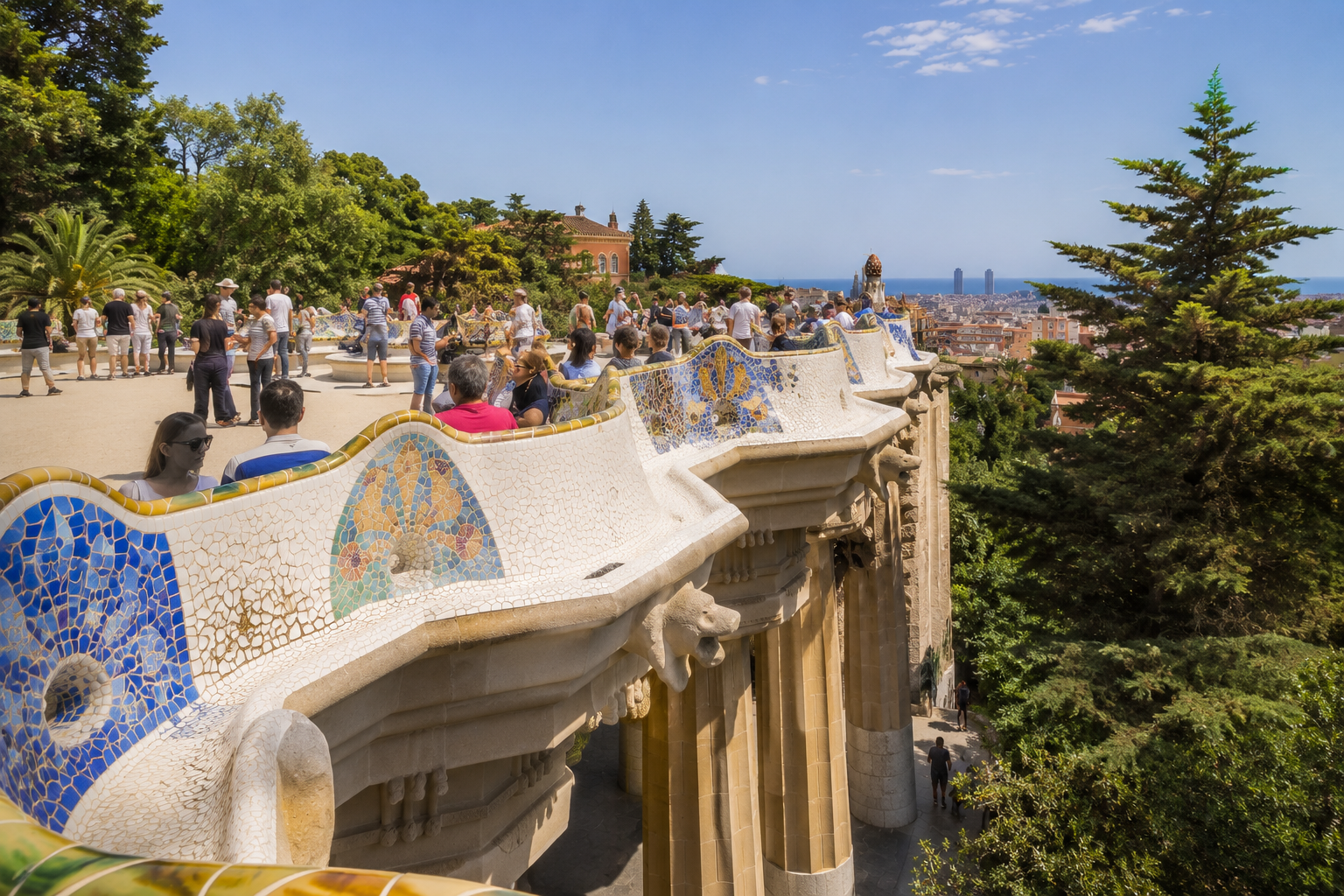
As you explore higher paths around the park, you'll encounter different perspectives across:
Barcelona
the Mediterranean
Sagrada Família
and the surrounding hills.
The viewpoints also help explain why the location was originally chosen for the ambitious residential project that became Park Güell.
Best for photography
The combination of Gaudí architecture in the foreground and Barcelona behind it is what makes Park Güell's views distinctive.
Barcelona has higher viewpoints.
But very few combine the city panorama with architecture this recognisable.
What Should You See First in Park Güell?
If you're entering near the main monumental entrance, a logical route is:
1. Porter's Lodge Pavilions
↓
2. Dragon Stairway & El Drac
↓
3. Hypostyle Room
↓
4. Nature Square
↓
5. Serpentine Bench
↓
6. Laundry Room Portico
↓
7. Viaducts & pathways
↓
8. Austria Gardens / Gaudí House Museum
↓
9. Higher viewpoints
This gives you the major architectural highlights first and then allows you to explore the quieter parts of Park Güell afterward.
Your exact route may vary depending on your entrance and current visitor circulation.
What Should You Not Miss at Park Güell?
If you're short on time, our five absolute must-sees are:
1. El Drac
The famous mosaic salamander.
2. Hypostyle Room
One of Park Güell's most impressive architectural spaces.
3. Serpentine Mosaic Bench
The park's iconic colourful seating.
4. Nature Square
For the classic Barcelona panorama.
5. Porter's Lodge Pavilions
For Gaudí's fairytale-like architecture.
If you see those five properly, you'll have experienced the core of Park Güell.
But we'd strongly recommend exploring farther if time allows.
What Can You See in Park Güell in One Hour?
One hour is enough to see many of the major highlights if you stay focused on the Monumental Zone.
Prioritise:
Dragon Stairway
El Drac
Hypostyle Room
Nature Square
Serpentine Bench
and
Porter's Lodge Pavilions.
Don't attempt to cover every pathway and viewpoint.
If you have more time, add the Laundry Room Portico and viaducts.
Not sure how much time to allow? Read our complete guide to how long you need at Park Güell.
What Can You See in Park Güell in 90 Minutes?
Around 75–90 minutes gives you a much more comfortable visit.
You'll have time to see the Monumental Zone without moving immediately from photo spot to photo spot.
You can also begin exploring:
Laundry Room Portico
viaducts
stone pathways
and potentially one of the quieter areas.
This is also a good amount of time for a guided visit because there's enough time to explain the architecture and history while moving through the main highlights.
Afterward, you can continue exploring independently if your ticket conditions permit.
What Are the Best Places for Photos in Park Güell?
For first-time visitors, we'd prioritise five locations.
El Drac
For the classic Park Güell photograph.
Nature Square
For panoramic Barcelona views.
Serpentine Bench
For colourful mosaic details.
Porter's Lodge Pavilions
For Gaudí architecture against the skyline.
Laundry Room Portico
For dramatic stone architecture and perspective.
Photography tip
Park Güell can become extremely busy.
If photography matters to you, choosing the right time can make a significant difference.
See our guide to the best time to visit Park Güell for advice on morning vs afternoon, crowds, weather and photography.
Is Park Güell Just the Monumental Zone?
No.
The famous architectural attractions are concentrated around the monumental areas, but Park Güell extends beyond the Dragon Stairway, Hypostyle Room and mosaic terrace.
The wider park includes:
paths
viaducts
gardens
viewpoints
and
natural areas.
This is why two visitors can spend very different amounts of time at Park Güell.
One person might see the major Gaudí landmarks and leave.
Another might spend considerably longer exploring the hillside.
Is the Monumental Zone the Best Part of Park Güell?
For a first visit, yes.
If you've never visited Park Güell before, we'd prioritise the Monumental Zone.
That's where you'll find many of the structures that made the park internationally famous.
However, we'd avoid treating the rest of Park Güell as irrelevant.
The quieter pathways and stone viaducts reveal another side of Gaudí's design philosophy and show how the architecture interacts with the landscape.
Think of it like this:
Monumental Zone
The icons
Wider Park
The landscape and context
Together, they provide the complete experience.
Do You Need a Guide to See Park Güell?
No.
You can visit Park Güell independently.
But there's an important difference between:
seeing the architecture
and
understanding why Gaudí designed it that way.
Without context, you may see:
“a colourful bench.”
With a knowledgeable guide, that same structure becomes part of a larger story about materials, ergonomics, drainage, landscape design and Gaudí's architectural philosophy.
The same applies to the Hypostyle Room, viaducts and entrance structures.
A guided tour is particularly worthwhile if:
It's your first visit
You're interested in Gaudí
You enjoy architecture
You want to understand the symbolism
You have limited time and want a structured route
Still deciding? Read our Park Güell guided tour vs self-guided comparison.
Is a Park Güell Guided Tour Worth It?
If you're mainly visiting for photographs and views, you may be happy exploring independently.
If you want to understand why Park Güell looks the way it does, a guided tour adds considerably more context.
A licensed guide can explain how the site evolved from an unsuccessful residential project into one of Barcelona's most famous attractions and help connect individual structures into Gaudí's wider vision.
Read our complete guide to whether a Park Güell guided tour is worth it.
What Else Should You See Near Park Güell?
Park Güell doesn't need to consume your entire day.
Depending on your schedule, you can combine it with other Barcelona attractions.
The obvious choice is:
Sagrada Família
Both are masterpieces associated with Antoni Gaudí, but they offer completely different experiences.
Park Güell shows his approach to:
landscape
public space
organic architecture
and
mosaic work.
Sagrada Família demonstrates his architectural ideas on a monumental religious scale.
Seeing both on the same Barcelona trip gives you a much better understanding of Gaudí's work.
Other options include exploring Gràcia, visiting Casa Batlló, or continuing into central Barcelona.
Our Recommended Park Güell Route
For a first visit, we'd use this simple strategy:
Start with the monumental architecture
See:
Porter's Lodge Pavilions → Dragon Stairway → El Drac → Hypostyle Room
Then move upward
Continue to:
Nature Square → Serpentine Bench
Then explore the quieter architecture
Walk through:
Laundry Room Portico → Viaducts → Stone pathways
Finish with views
Spend your remaining time exploring:
gardens and higher viewpoints.
This route gives you the famous attractions first while still leaving room to discover the less obvious parts of Park Güell.
Our Top 5 Park Güell Highlights
If we had to choose only five:
#1 El Drac
Park Güell's most recognisable symbol.
#2 Nature Square & Serpentine Bench
For Gaudí mosaics and Barcelona views.
#3 Hypostyle Room
For architecture and engineering.
#4 Porter's Lodge Pavilions
For the fairytale entrance architecture.
#5 Laundry Room Portico
For Gaudí's extraordinary use of natural stone.
Together, these five show the diversity that makes Park Güell much more than simply a colourful Barcelona photo spot.
Ready to Discover Park Güell?
Park Güell is easy to photograph.
It's much harder to understand without knowing the story behind what you're seeing.
From the drainage system hidden within the architecture to the symbolism, trencadís mosaics, unusual columns and original residential plan, many of the park's most interesting details aren't immediately obvious.
For a first visit, a guided tour can help you experience the major highlights in a logical route while understanding why Gaudí created them.
Explore Park Güell Guided Tours →
Frequently Asked Questions
What should I not miss at Park Güell?
The main Park Güell highlights are the Dragon Stairway and El Drac, Nature Square, the serpentine mosaic bench, Hypostyle Room and Porter's Lodge Pavilions. If you have more time, explore the Laundry Room Portico and Gaudí's stone viaducts.
What is the most famous thing to see in Park Güell?
El Drac, the colourful mosaic salamander on the Dragon Stairway, is probably Park Güell's most recognisable attraction and one of the best-known symbols of Gaudí's work in Barcelona.
What is the best view in Park Güell?
Nature Square provides the classic Park Güell panorama, combining the colourful entrance pavilions with views across Barcelona. Higher paths around the park offer additional city viewpoints.
How long do you need to see Park Güell?
Around 75–90 minutes is suitable for seeing the major highlights at a comfortable pace. Visitors who want to explore the wider pathways, gardens and viewpoints may want longer.
Can you see Park Güell in one hour?
Yes. In one hour, focus on the Monumental Zone, including El Drac, Dragon Stairway, Hypostyle Room, Nature Square, serpentine bench and entrance pavilions.
Is the Gaudí House Museum worth visiting?
It's particularly worthwhile for visitors interested in Antoni Gaudí's life. If you have limited time, however, prioritise Park Güell's main monumental architecture first.
What are the best places for photos in Park Güell?
El Drac, Nature Square, the serpentine mosaic bench, Porter's Lodge Pavilions and Laundry Room Portico are among the best photography locations in Park Güell.
Do you need a guided tour to see Park Güell?
No. Park Güell can be visited independently. A guided tour is most useful for visitors who want to understand Gaudí's architecture, symbolism, engineering and the history behind the park.